
Hair Loss Clinic Malaysia: A Complete Guide to Understanding Hair Loss, Treatment and Hair Restoration
Hair loss can start quietly. You may notice more hair on your pillow, a wider parting, a receding hairline, or a thinner crown. At first, it may seem like a small cosmetic issue. However, as the thinning continues, it can affect how you see yourself, how you feel in photographs, and even how confidently you meet other people.
For many Malaysians, searching for the right hair loss clinic Malaysia has therefore become an important first step. Yet choosing a clinic should involve more than looking at before-and-after photographs or comparing treatment prices.
At InterClinic Medicine & Surgery Clinic, we believe hair loss deserves a medical approach. Instead of simply asking how to grow more hair, we first ask a more important question: Why are you losing your hair?
That distinction matters. Different types of hair loss have different causes, and the best treatment depends on the condition of your scalp, follicles, overall health, pattern of hair loss, donor hair supply, lifestyle, and personal goals.
Our Hair Restoration Unit combines medical assessment, surgical hair restoration, non-surgical treatments, and long-term support. The aim is simple: help you understand your hair loss and choose a treatment plan that looks natural and makes sense for you.
Why Choose a Hair Loss Clinic Instead of Guessing at Home?
Hair loss is common, but that does not mean every case should be treated in the same way.
For example, genetic hair loss may gradually affect the hairline and crown. Meanwhile, stress, illness, nutritional problems, hormonal changes, scalp conditions, certain medicines, or excessive hair treatments can also contribute to shedding. Sometimes, several factors occur at the same time.
Therefore, simply buying another shampoo may not solve the real problem.
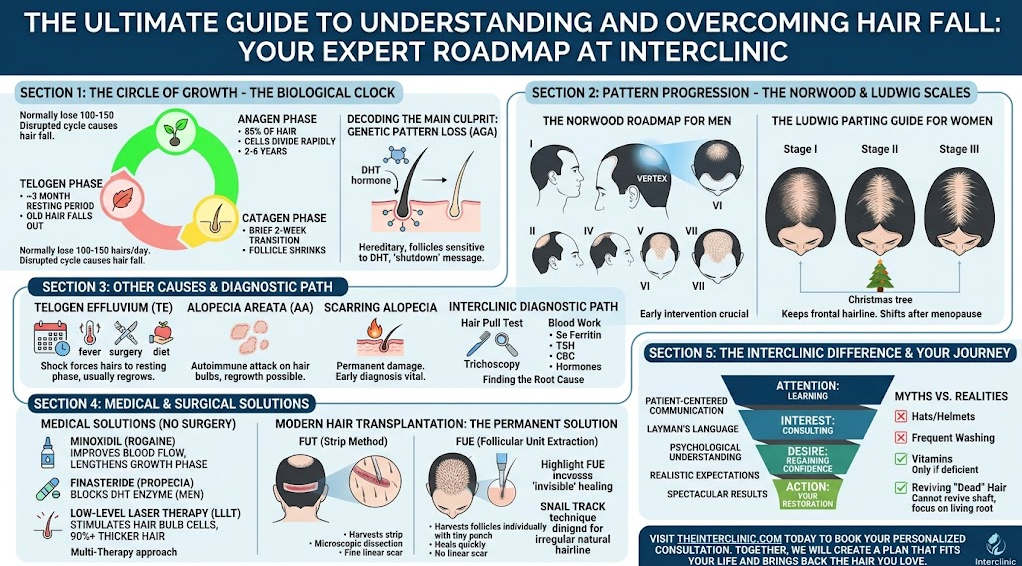
A proper consultation gives you an opportunity to understand what is happening before committing to treatment. At InterClinic, assessment may include your medical history, family history, hair-loss pattern, scalp examination, donor-area assessment, hair density evaluation, and, when appropriate, laboratory investigations.
More importantly, we look at the person behind the hair loss.
Your age matters. Your existing density matters. Your family history matters. Your scalp health matters. Your expectations matter too.
Consequently, treatment should be personalised rather than based on a one-size-fits-all package.
What Causes Hair Loss?
Understanding the cause is the foundation of good hair restoration.
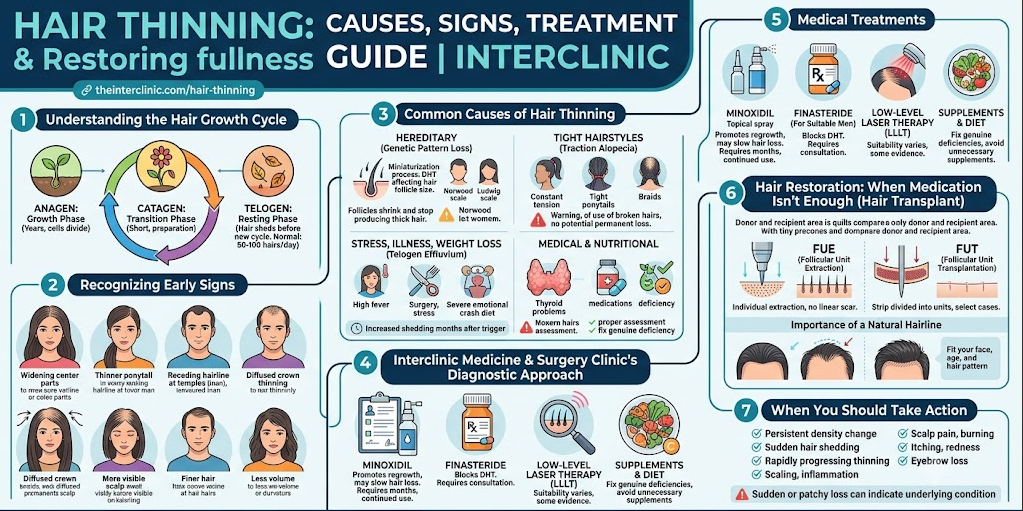
1. Genetic Hair Loss
Genetic or pattern hair loss is one of the most common reasons for progressive thinning in both men and women.
In men, it often begins with a receding hairline, thinning around the temples, or reduced density at the crown. Over time, these areas can become increasingly visible.
Women may experience a different pattern. Instead of a receding hairline, they may notice a wider parting or general thinning across the top of the scalp.
Because genetic hair loss can progress gradually, early assessment may give you more treatment options.
2. Stress and Illness
Significant physical or emotional stress can sometimes trigger increased shedding.
For instance, hair may enter a resting phase earlier than usual after illness, major stress, rapid weight loss, or other physical challenges. The increased shedding may become noticeable weeks or months later.
However, excessive shedding does not automatically mean permanent baldness.
Therefore, identifying the trigger is important before assuming that a hair transplant is necessary.
3. Nutrition
Hair follicles require adequate nutrition to function normally.
Low intake of important nutrients or certain nutritional deficiencies may contribute to poor hair quality or increased shedding. For that reason, your medical assessment may include nutritional considerations when appropriate.
Still, supplements are not a universal answer.
Taking multiple hair supplements without knowing whether you actually need them may add cost without addressing the underlying problem. A medically guided approach is more sensible.
4. Hormonal and Medical Factors
Hormonal changes and certain medical conditions can affect hair growth.
Thyroid problems, hormonal changes, inflammatory scalp conditions, some medications, and other health issues may contribute to hair loss. InterClinic therefore considers your broader medical history rather than looking only at the scalp.
Likewise, sudden or unusual hair loss deserves proper medical evaluation.
5. Scalp Problems
Healthy follicles need a healthy scalp environment.
Persistent inflammation, scalp disorders, infections, severe dandruff, or other scalp problems may affect hair quality and growth.
As a result, treating the scalp condition may become an important part of your hair restoration plan.
When Should You Visit a Hair Loss Clinic Malaysia?
You do not necessarily need to wait until you develop a large bald area.
In fact, earlier assessment can be useful when you notice persistent changes.
You may consider a consultation if:
- Your hairline is gradually receding.
- Your crown is becoming thinner.
- Your parting looks wider than before.
- You notice increased daily shedding.
- Your ponytail feels smaller.
- Your scalp is becoming more visible.
- You have a family history of baldness.
- Your hair has become noticeably finer.
- You have sudden or unexplained hair loss.
- You have scalp itching, inflammation, or other scalp changes.
- You have tried several products without improvement.
- You are considering a hair transplant.
- You want to understand your options before your hair loss progresses further.
Most importantly, you do not have to decide on surgery during your first consultation.
A good consultation should help you understand your situation first. Then, you can make an informed decision.
How Is Hair Loss Assessed at InterClinic?
At InterClinic, hair restoration starts with assessment rather than immediately recommending a procedure.
First, we discuss your concerns and history. We may ask when your hair loss began, how quickly it has progressed, whether relatives have similar hair loss, what treatments you have tried, and whether you have experienced recent changes in health, stress, diet, medication, or lifestyle.
Next, we examine your scalp and hair.
We look at the pattern of thinning and the quality of your existing hair. We also assess the donor area because transplanted hair needs to come from a suitable source.
Where appropriate, scalp imaging, magnification, donor mapping, hair-density assessment, and laboratory testing can provide additional information.
After that, we discuss realistic options.
This process is important because two people with apparently similar baldness may need completely different treatment strategies.
Hair Loss Treatment Options at InterClinic
There is no single best hair loss treatment for everyone.
Instead, treatment depends on the diagnosis, severity, goals, donor supply, health status, and expectations.
InterClinic provides both surgical and non-surgical approaches to hair restoration. These may include medical treatment, PRP therapy, low-level laser therapy, microneedling-based approaches, scalp micropigmentation, and hair transplantation where appropriate.
Medical Hair Loss Treatment
Some patients may benefit from medical treatment to help manage ongoing hair loss.
Depending on the diagnosis, medical therapy may involve topical or oral treatments. However, medication is not suitable for everyone.
For that reason, treatment should be selected after medical assessment rather than based on online recommendations.
The goal is not simply to chase new hair growth. Instead, the goal is to create a sustainable plan for your existing hair and overall scalp health.
PRP Hair Treatment
Platelet-rich plasma, commonly called PRP, is another option used in hair restoration.
The treatment uses a preparation derived from your own blood and delivers it to selected areas of the scalp.
PRP may be considered as part of a broader hair restoration programme. In some cases, it can complement other approaches.
However, PRP should not be marketed as a guaranteed cure for every type of baldness.
Your diagnosis still comes first.
Low-Level Laser Therapy
Low-level laser therapy, or LLLT, is a non-surgical approach that may be incorporated into selected hair restoration plans.
Because it does not involve hair transplantation, it may appeal to people who prefer non-surgical options.
Nevertheless, suitability varies from person to person. A consultation can help determine whether it makes sense for your situation.
Scalp Micropigmentation
Scalp micropigmentation creates the visual appearance of greater hair density by placing pigment into the scalp.
It does not create new hair follicles.
Instead, it can provide a cosmetic solution for selected individuals, particularly those who prefer a closely cropped hairstyle or want to improve the visual appearance of thinning areas.
Hair Transplantation
For suitable candidates, hair transplantation can provide a more permanent way to redistribute existing hair follicles from a donor area to areas affected by thinning or baldness.
The key word is redistribute.
A hair transplant does not create an unlimited supply of new follicles. Therefore, careful donor-area planning is essential.
At InterClinic, hair transplantation may involve techniques such as FUE or FUT depending on the individual’s circumstances.
What Is FUE Hair Transplant?
FUE stands for Follicular Unit Extraction.
During FUE, individual follicular units are carefully extracted from the donor area and transplanted into areas that require additional density.
Because the follicles are removed individually rather than through a single strip incision, FUE generally produces small extraction marks rather than one linear scar.
It can therefore be attractive to people who prefer shorter hairstyles.
However, FUE is not simply about extracting as many grafts as possible.
The donor area has limits.
Therefore, good planning should balance immediate improvement with the long-term appearance of the donor area.
What Is FUT Hair Transplant?
FUT stands for Follicular Unit Transplantation.
This technique involves removing a strip of scalp from the donor area and separating it into individual grafts for transplantation.
Although FUE receives considerable attention online, FUT can still have a role in selected cases.
Consequently, the question should not simply be, “Which technique is more popular?”
A better question is, “Which technique is appropriate for my hair loss, donor supply, hairstyle, and long-term goals?”
That is why personalised assessment matters.
Does Hair Transplantation Look Natural?
Natural results depend on much more than placing grafts into empty areas.
The hairline must suit your face, age, existing hair, and expected future hair loss. Graft direction also matters. Density matters. Donor management matters.
Furthermore, an excessively low or aggressively designed hairline may look unnatural as you age.
At InterClinic, the emphasis is therefore on natural-looking restoration rather than simply maximising the number of grafts. The clinic’s hair restoration approach considers hairline design, donor-area integrity, graft survival, and long-term appearance.
The objective is for the restored hair to look like it belongs to you.
What Happens During a Hair Restoration Journey?
Your journey normally starts with consultation.
Then, the team evaluates your hair loss and discusses suitable options. If transplantation is appropriate, the procedure is planned according to the number of grafts required and the available donor supply.
After treatment, proper aftercare becomes important.
The early period can involve temporary redness, swelling, sensitivity, or shedding. Initial transplanted hairs may also shed before new growth becomes visible.
Therefore, patience is essential.
Hair does not grow overnight.
Instead, the restoration process develops over months, and the final appearance takes time to mature.
Follow-up allows your progress to be monitored and your long-term plan adjusted when necessary.
Why Natural Hair Restoration Requires Long-Term Thinking
One common mistake is to think of hair transplantation as a one-time cosmetic fix.
However, your original hair can continue to thin even after a transplant.
For example, you may restore the front hairline while existing hair behind it continues to miniaturise.
Consequently, long-term planning is critical.
A sensible hair restoration strategy may combine transplantation with appropriate medical treatment, scalp care, nutritional optimisation, lifestyle improvements, or other supportive therapies.
This integrated approach is one of the principles behind InterClinic’s Hair Restoration Unit.
How Do You Choose the Best Hair Loss Clinic Malaysia?
Searching online for the “best hair loss clinic Malaysia” can produce hundreds of results.
Yet rankings and advertisements cannot tell you everything.
Instead, look for a clinic that:
- Starts with diagnosis rather than immediately selling a procedure.
- Explains your options in simple language.
- Discusses benefits, limitations, risks, and alternatives.
- Assesses your donor area before promising graft numbers.
- Provides realistic expectations.
- Offers both surgical and non-surgical options where appropriate.
- Provides follow-up care.
- Uses appropriate medical facilities and safety protocols.
- Focuses on natural-looking outcomes.
- Treats you as an individual rather than a package.
In addition, consider whether you feel comfortable asking questions.
Hair loss can be emotional. You should be able to discuss your concerns without feeling pressured.
Why Consider InterClinic for Hair Loss Treatment in Malaysia?
InterClinic Medicine & Surgery Clinic combines medical care with hair restoration and aesthetic expertise.
The clinic’s Hair Restoration Unit provides assessment and treatment options for hair thinning, pattern baldness, alopecia, and other hair-related concerns. Its approach combines surgical and non-surgical treatments with diagnostic assessment and ongoing support.
Dr. Ruzaidi leads the clinic and has worked in medicine since graduating from medical school in 2005. His experience includes government hospital practice, private medicine, surgery, pathology, emergency care, aesthetic medicine, and specialised hair restoration training.
Importantly, InterClinic’s approach is not built around one procedure.
Instead, the clinic focuses on understanding the patient’s needs before recommending an appropriate pathway.
That means you may discover that you do not need a hair transplant yet.
Alternatively, you may discover that transplantation is appropriate and can be combined with supportive treatment.
Either way, the decision should come from proper assessment.
Hair Loss Is More Than a Cosmetic Problem
For some people, losing hair feels surprisingly emotional.
You may feel older than you are. You may avoid photographs. You might wear a cap more often. You may become increasingly conscious of your appearance when meeting clients, colleagues, friends, or potential partners.
These feelings are real.
At the same time, treatment should not be driven by fear or unrealistic promises.
The right approach is to understand what can realistically be improved and then choose the safest suitable option.
In other words, hair restoration should improve confidence without creating unrealistic expectations.
Frequently Asked Questions About Hair Loss Clinic Malaysia
Is hair loss normal?
Some daily hair shedding is normal. However, persistent excessive shedding, progressive thinning, visible scalp, or a changing hairline deserves assessment.
Can hair loss be treated without surgery?
Yes. Depending on the cause, non-surgical options may include medical therapy, PRP, low-level laser therapy, scalp treatments, nutritional optimisation, or other supportive approaches.
Is FUE suitable for everyone?
No. FUE requires an adequate donor supply and suitable recipient areas. Your diagnosis, hair characteristics, expectations, and long-term pattern of hair loss also matter.
Is hair transplant permanent?
Transplanted follicles are generally intended to provide long-term growth, but your non-transplanted hair can continue to thin. Therefore, long-term management may still be important.
Is a hair transplant painful?
FUE is performed using local anaesthesia, so significant pain during the procedure is generally minimised. Some temporary discomfort can occur afterward.
How long does it take to see results?
Hair restoration is gradual. Initial shedding may occur, while visible new growth develops over the following months. Final results take time to mature.
Should I wait until I become bald before getting treatment?
Not necessarily.
Earlier assessment can help identify the cause of hair loss and provide more opportunities for management. However, the correct timing depends on your individual condition.
How much does hair transplant cost in Malaysia?
The cost varies according to the technique, number of grafts, complexity, donor supply, treatment plan, and other factors. Therefore, an accurate quotation should follow a proper assessment rather than a generic online price.
Take the First Step Before the Hair Loss Gets Worse
If you are searching for a hair loss clinic Malaysia, start with understanding your hair loss rather than immediately choosing a procedure.
Your hair is unique.
Your scalp is unique.
Your donor supply is unique.
Therefore, your treatment plan should be unique too.
At InterClinic Medicine & Surgery Clinic, our approach combines medical assessment, hair restoration expertise, surgical and non-surgical options, and long-term support. We aim to help you make an informed decision based on your condition, goals, and realistic expectations.
Whether you are noticing early thinning, a receding hairline, crown baldness, or more advanced hair loss, you do not have to navigate the options alone.
Start with a consultation.
Understand the cause.
Explore your options.
Then decide what is right for you.
Your Hair Restoration Journey Starts With One Conversation
If you are ready to understand your hair loss, contact InterClinic Medicine & Surgery Clinic for a personalised hair restoration consultation.
InterClinic Medicine & Surgery Clinic
📍 Jalan USJ 21/10, USJ 21, Subang Jaya, Malaysia
📞 +60 18-352 5359
💬 WhatsApp / Call for appointment enquiries
🕘 Monday–Friday: 9:00 AM–6:00 PM
🕘 Saturday: 9:00 AM–1:00 PM
🚫 Sunday & Public Holidays: Closed
Visit InterClinic Medicine & Surgery Clinic
The clinic is based in Subang Jaya and provides hair restoration alongside other medical and surgical services.
Do not wait until hair loss becomes the only thing you notice in the mirror. Find out what is happening, understand what can be done, and make your decision with confidence.